
The most important cue in the room is usually the one you say out loud.
That is also the problem.
You know the principles. You understand sensory input, cognition, coordination, balance, timing, and movement control. You know when to simplify and when to progress. You know what a clean response looks like and what a compensation looks like.
The constraint is rarely your knowledge.
The constraint is usually the cue.
When you are the one calling "left", "now", "blue", the task runs at the speed of your voice. You cannot cue and observe at the same time. The timing drifts between repetitions. Your client starts reading you instead of reading the task.
That is why neuro-athletic training often stops short of what it is designed to do.
At some point, the cue has to leave your voice and live in the task, so your client can:
Perceive → Decide → Move
This is where cognitive-motor training becomes practical.
For A-Champs, cognitive-motor training for neuro-athletic work is not brain training separate from movement. It is not lights added to a drill for effect. It is not a replacement for your assessment.
It is professional task design that connects cueing, decision-making, movement, feedback, and progression under controlled but progressively challenging conditions.
The goal is not to make your sessions more complicated.
The goal is to let your expertise run the session instead of running the stopwatch.
Neuro-Athletic Training Is More Than the Cue You Give
Manual cueing is not wrong. It is how most of this work started, and in many sessions it is still the right call.
But it carries costs that are easy to stop noticing.
A spoken cue cannot be repeated identically. Your tone changes. Your timing changes. Your position in the room tells your client something before you speak. Over a block of repetitions, they learn your pattern rather than the pattern of the task.
A spoken cue also occupies you. While you are cueing, you are not observing posture, hesitation, gaze, or the quality of the first step.
And a spoken cue is hard to progress precisely. "A bit faster" is not a parameter you can set again next week.
The movement matters.
But the movement only makes sense in relation to the information your client is responding to, and to who is delivering it.
That is the gap cognitive-motor training is designed to address.
| Manual cueing | Environment-based cueing | |
|---|---|---|
| Where the cue comes from | You: voice, pointing, gesture. | The task: light, sound, vibration, symbol, sequence. |
| What your client reads | You, and often your intention before the cue. | The rule, which does not telegraph. |
| Your role during the task | Delivering the cue and observing at the same time. | Observing the response and coaching it. |
| Repeatability | Varies with your timing and position. | Same rule, same parameters, next session. |
| How you progress it | By feel, described in words. | By changing a named parameter you can set again. |
This is not a claim that environment-based cueing is clinically superior.
It is a claim about control. You gain a task you can repeat, observe, and progress deliberately.
What Cognitive-Motor Training Means in Neuro-Athletic Work
Cognitive-motor training means designing tasks where movement is connected to information, a decision, feedback, and a progression.
That means your client is not only asked to move.
They are asked to solve a task while moving.
A cognitive-motor task may require your client to:
- read a visual cue that defines where the response goes;
- respond to a sound that changes the timing;
- read a tactile cue that directs awareness without loading vision;
- interpret a rule before acting;
- choose between responses;
- inhibit the wrong response, so not every cue is a go;
- hold a sequence while already moving;
- move with control while processing information;
- receive feedback and progress the next repetition.
The key point is simple:
Your client should not only complete the movement. They should read what the task is asking before they move.
This is why A-Champs positions neuro-athletic training under Professional Cognitive-Motor Training, not under basic reaction training. The broader methodology connects perception, decision-making, movement, feedback, and progression in one professional training environment.
Perceive → Decide → Move in Neuro-Athletic Work
A-Champs explains Reactive Intelligence through a simple public model:
Perceive → Decide → Move
Perceive means reading the cue, the rule, the space, the body position, or the change in demand.
Decide means interpreting that information, inhibiting the wrong response, and choosing the right one.
Move means executing with timing, balance, coordination, and control.
Neuro-athletic work tends to live in the middle stage.
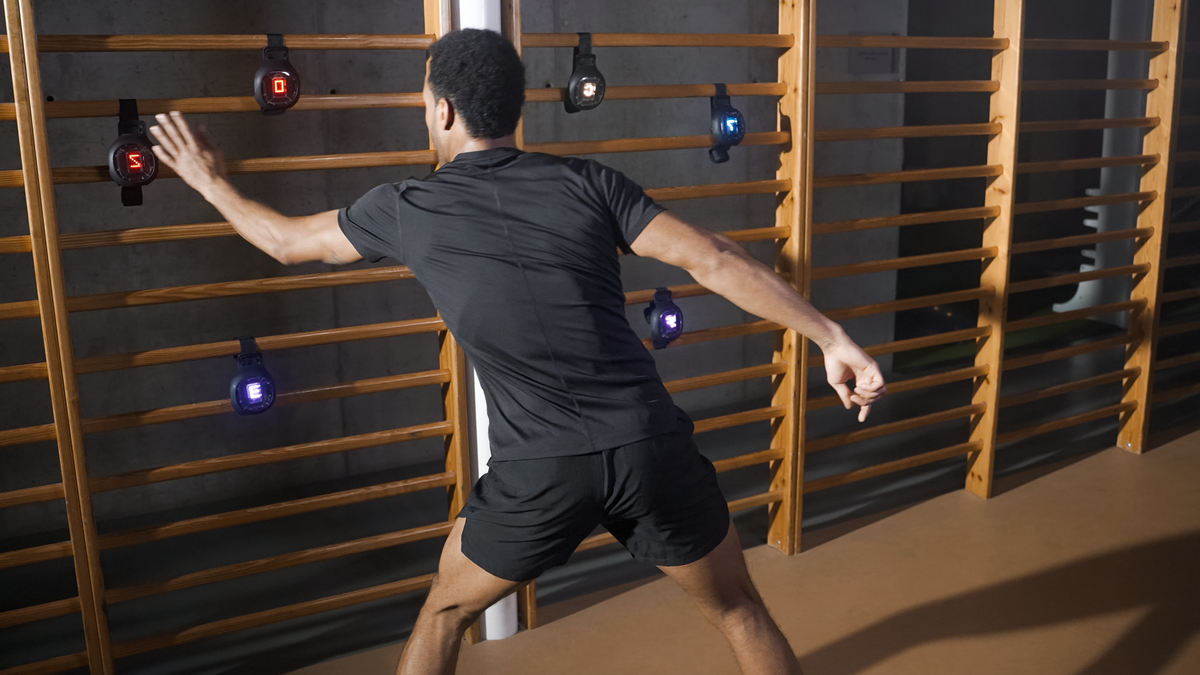
Your client may perceive a number on an LED matrix. They may decide which of five stimuli comes next in the sequence, and hold that order while their body is already moving. They may move through the correct stimulus without stopping, while you watch head position, trunk control, and whether the decision cost them their balance.
Feedback then tells you what comes next.
That may mean simplifying the rule, repeating the task, changing the cue channel, adding a choice, reducing predictability, or moving closer to the demand your client is preparing for.
Which is why the working loop is longer than the public model:
Perceive → Decide → Move → Feedback → Progression
Processing is not removed. It sits inside the Decide stage. The public model stays clear, while the working loop gives you somewhere to put your professional decisions.
Why Reaction Time Alone Is Incomplete
Reaction time has value.
It can measure how quickly someone responds to a signal. It can create focus, urgency, and engagement. It can be useful inside a larger training process.
But a reaction drill asks one question: how fast did the response arrive?
Neuro-athletic work usually needs more than that.
A fast response to a predictable light does not tell you whether your client recognised the rule, chose the right option, inhibited the wrong one, or kept control of the movement once they committed to it.
The better question is not only:
How fast did they react?
The better questions are:
What did they have to recognise?
What decision did the task create?
Did the movement survive the decision?
Can the task be progressed?
This is where cognitive-motor training goes further.
It places reaction speed inside a larger loop: cueing, decision-making, movement, feedback, and progression.
What You Can Train Through Cognitive-Motor Tasks
Cognitive-motor tasks can target many qualities that matter in neuro-athletic work.
These should be understood as training targets, not guaranteed outcomes.
You may design tasks that challenge:
- recognition;
- choice;
- inhibition;
- sequencing;
- attention shifting;
- timing;
- balance and body control;
- coordination;
- movement under cognitive load;
- adaptability as conditions change.
The value comes from how these targets are built into the task.
A practical progression might look like this: start with one clear cue and one response. Add a rule, so the cue has to be interpreted. Add a second option, so there is a genuine choice. Add an inhibition condition, so not every cue is a go. Add a sequence to hold while moving. Add balance, direction, or posture demand. Then reduce predictability.
Not every client needs every step. Some sessions should stop at step two.
Complexity is not the goal.
A reliable connection between information and movement is the goal.
Cueing and Feedback Are Not the Same Thing
This distinction matters more in neuro-athletic work than almost anywhere else, because both arrive through the same channels.
Cues guide what the person should notice, interpret, or do. They come before the response.
Feedback helps you and the person understand what happened. It comes after.
A light may guide attention. A sound may set the timing. Vibration may direct awareness, or, in selected contexts, return information about what the response was.
The umbrella language is multisensory cueing and feedback. When shorter wording is needed, multisensory cueing is usually enough.
Keeping the two apart protects the quality of the work. If you cannot say whether a signal is guiding the task or reporting on it, your client probably cannot either. There is more on this in Multisensory Cueing Explained.
You Remain the Decision-Maker
Technology can deliver a cue.
Technology can hold a rule.
Technology can create variability you could not produce by voice.
Technology can record timing and support progression.
But you still define the objective.
You decide what your client should perceive.
You decide what decision the task should create.
You choose the movement response.
You observe the quality of that response.
You interpret the feedback.
You progress or simplify the task.
That is essential to the A-Champs position.
A-Champs is not a clinical tool. It is not a gadget that replaces professional expertise.
It is a professional system that gives you more ways to design, control, and progress cognitive-motor tasks.
How A-Champs Supports Neuro-Athletic Task Design
The methodology comes first.
The products make it practical.
A-Champs helps you build tasks that connect cueing, decision-making, movement, feedback, and progression.
That is the foundation of Professional Cognitive-Motor Training for Reactive Intelligence.
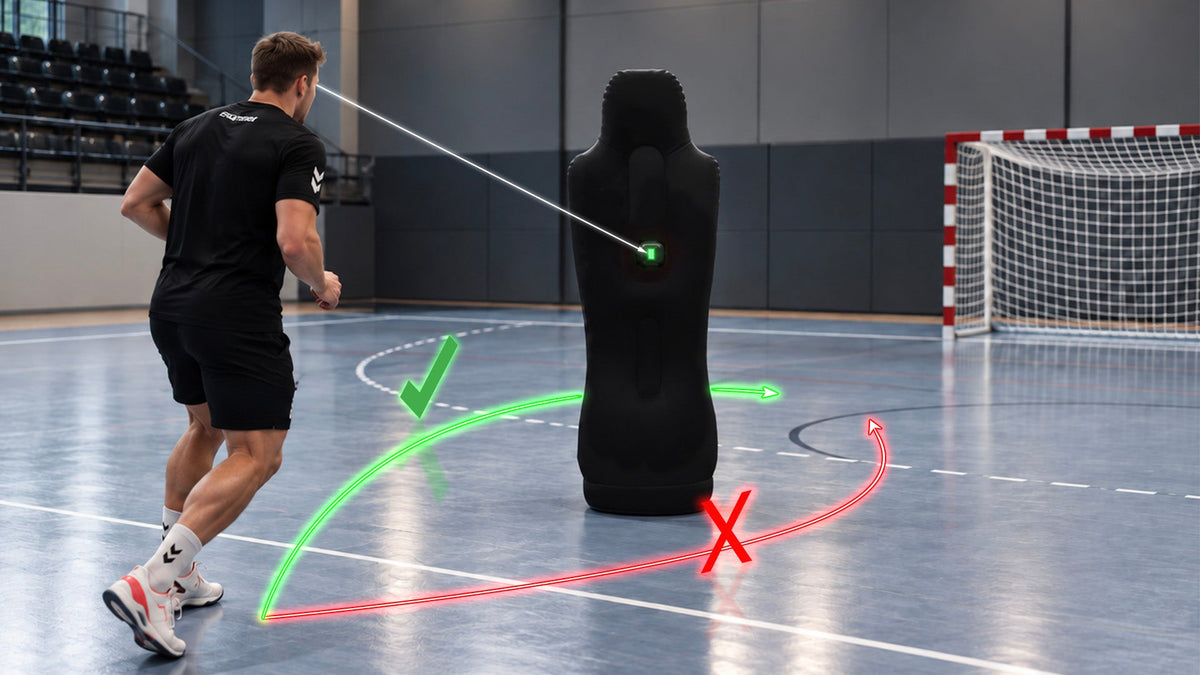
ROXProX Laser is the flagship A-Champs system and the most relevant one for neuro-athletic work. Laser-beam sensing lets your client move through the stimulus instead of stopping to tap, which preserves the movement you are trying to observe. The LED matrix adds letters, numbers, and symbols, so a task can require recognition, choice, inhibition, and sequencing rather than speed alone.
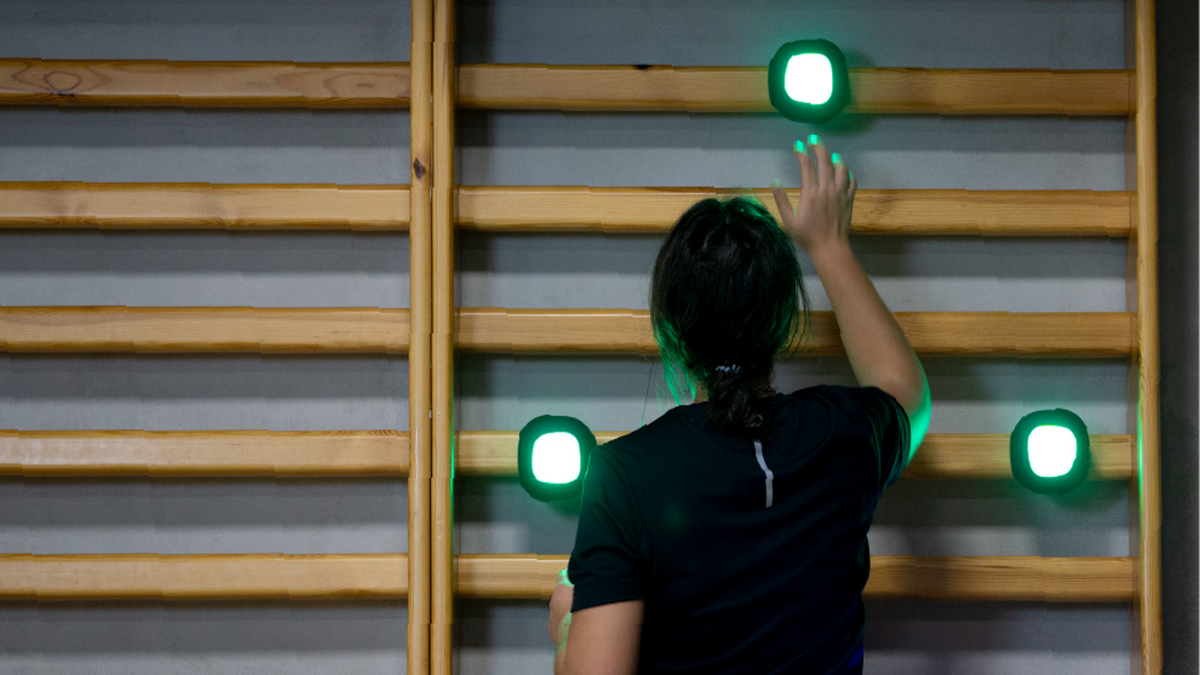
ROX Touch is the professional entry point into the A-Champs ecosystem. It supports accessible cognitive-motor tasks through visual, auditory, and tactile cueing, with 12 sensitivity levels that allow you to adjust the interaction to the user, the task, and the training environment.
CogniCage expands the methodology into an immersive facility-level environment. It supports whole-body cognitive-motor tasks involving space, movement, scanning, reaching, stepping, balance, coordination, and 360° interaction.
The product hierarchy matters.
ROXProX Laser remains the flagship proof of the methodology. ROX Touch, CogniCage, and accessories extend the ecosystem without replacing it.

The Claims Question: Stay Honest
Neuro-athletic language invites overreach, so this is worth stating plainly.
Cognitive-motor training is a way to design tasks.
It is not a treatment. It does not diagnose. It does not make claims about neurological change. It does not guarantee transfer to any specific real-world situation.
The credible position is more disciplined:
A-Champs helps you design cognitive-motor tasks that connect cueing, decision-making, movement, feedback, and progression under controlled, progressively challenging conditions.
That is a smaller claim than the category usually makes.
It is also one you can defend to a colleague.
It respects the complexity of the work. It respects your role. It protects the scientific integrity of the brand.
What You Should Ask Before You Add a Cognitive Demand
Before you add more cues, complexity, or technology, ask better questions:
- What should your client perceive, and through which channel?
- What is the decision you are actually asking for?
- Is the movement response the one you want to observe?
- Can you repeat this task next week with the same parameters?
- What feedback will tell you whether to progress or simplify?
- Is the added complexity serving the objective, or just filling the session?
These questions keep cognitive-motor training professional.
They also prevent the common mistake of confusing complexity with quality.
A task is not better because it has more cues.
A task is better when the cues, decisions, movements, feedback, and progression serve the training objective.
Build the Rule. Train the Response.
Neuro-athletic training has never been short of principles.
What it has often been short of is a way to deliver those principles the same way twice, without your voice sitting in the middle of the task.
That is the shift. The cue moves into the environment. The rule becomes a parameter you can set. Your attention returns to the response.
A-Champs gives you a system to design and progress these tasks. See how it fits together in Neuro-Athletic Training with A-Champs.
The objective is Reactive Intelligence.
Not faster tapping.
Not random complexity.
A task that is yours, and that repeats.
Frequently Asked Questions
What is neuro-athletic training?
Neuro-athletic training integrates sensory information, cognition, coordination, balance, timing, and movement control into one approach to movement work. A-Champs supports it by helping qualified professionals design structured cognitive-motor tasks that connect cues, decisions, movement, feedback, and progression.
How is cognitive-motor training different from reaction training?
Reaction training measures how fast a response arrives after a cue. Cognitive-motor training adds the demands that sit between the cue and the response: recognition, choice, inhibition, sequencing, and movement control under cognitive load. Reaction training is one entry point into the method, not the whole method.
Why move the cue out of the practitioner's voice?
A spoken cue cannot be repeated identically, it occupies the practitioner who should be observing, and it is hard to progress with precision. An environment-based cue keeps the parameters constant between sessions, does not telegraph the answer, and frees the professional to coach the response rather than deliver the stimulus.
Which A-Champs system suits neuro-athletic training best?
ROXProX Laser is the most advanced option, because laser-beam sensing lets the client move through the stimulus instead of stopping to tap, and the LED matrix supports recognition, choice, inhibition, and sequencing. ROX Touch is the accessible entry point for visual, auditory, and tactile cueing.
Can cognitive-motor training be used alongside an existing method?
Yes. The professional defines the goal, the rules, the coaching focus, and the progression. Cognitive-motor tools provide a way to make those tasks more dynamic, structured, and repeatable; they do not prescribe a method of their own.