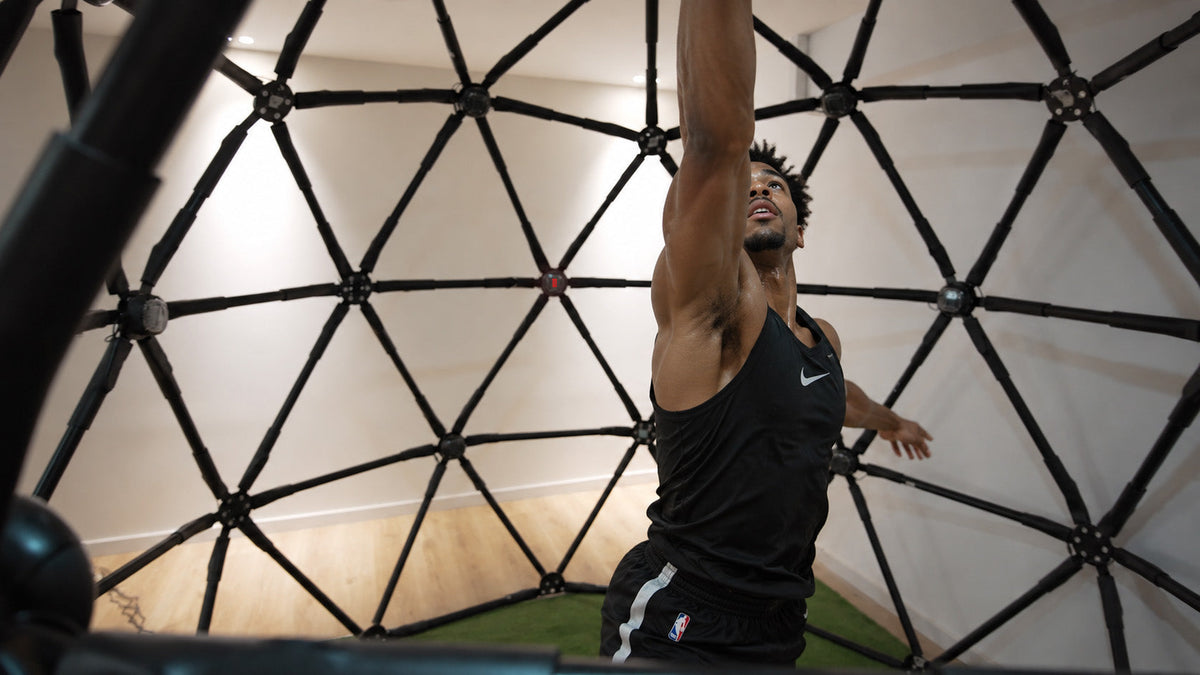


Short answer: Reaction training in return-to-play rehab uses timed cues, usually lights, sounds or vibration, to retrain how quickly and accurately a patient perceives a stimulus and responds with a controlled movement. It is used as an adjunct to standard rehabilitation in settings such as ACL reconstruction, sport-related concussion and stroke recovery, where reaction time and sensorimotor control are known to be affected. The evidence base supports reaction time as a clinically relevant measure of recovery and readiness, and reaction-light systems give clinicians an objective, repeatable way to deliver and measure that work.
This guide covers why reaction time matters after injury, what the literature shows across ACL, concussion and stroke, the tools clinicians use, and a sample criteria-based protocol. Protocols should always be set and progressed by a qualified clinician for the individual patient.
Strength and range of motion return first in most rehabilitation programs, but the ability to react, decide and move under unpredictable conditions often lags behind. That gap matters, because sport and daily life are reactive. Reaction training addresses it directly, and reaction-light systems let clinicians measure it rather than estimate it. This article is written for physiotherapists, athletic trainers and return-to-play clinicians who want an evidence-informed view of where reaction training fits.
What is reaction training in return-to-play rehab?
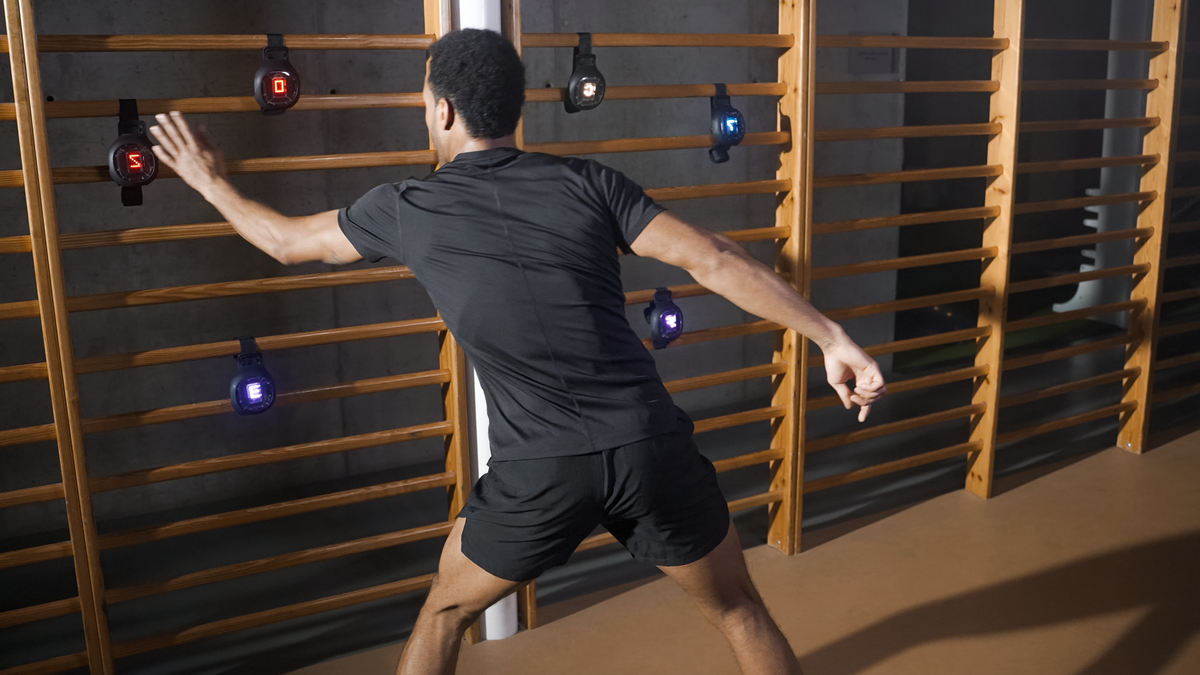
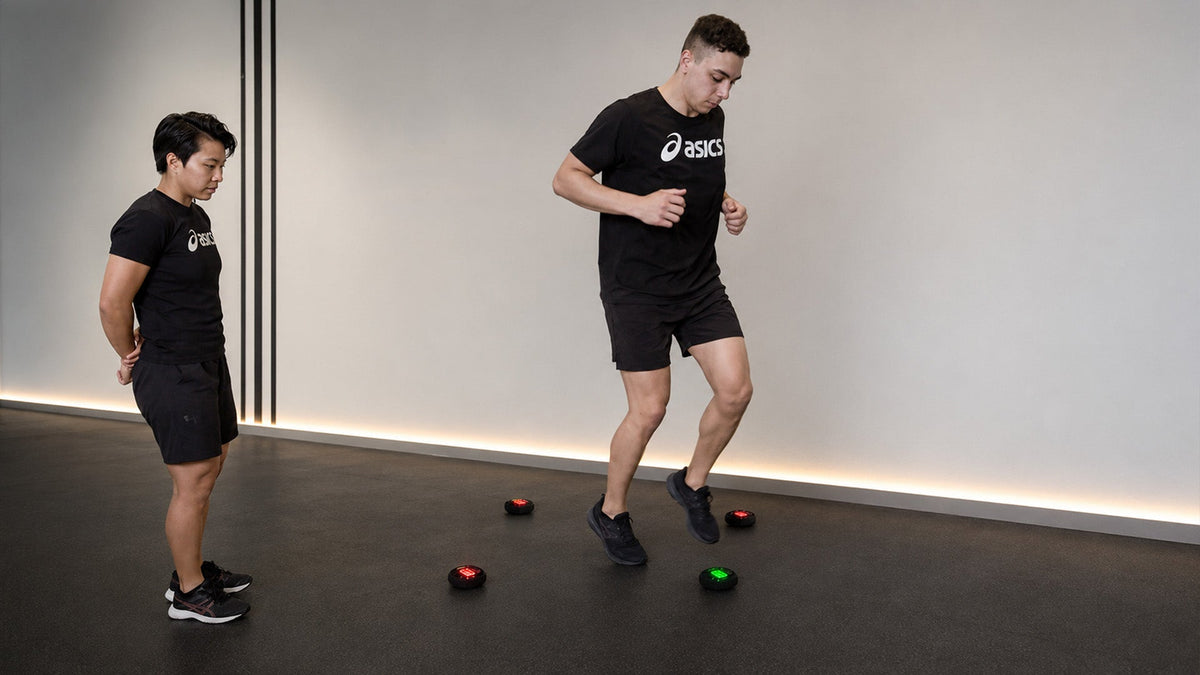
Reaction training presents a timed, often unpredictable cue and asks the patient to respond with a specific movement. The cue can be a light, a sound or a vibration, and the response can be a reach, a step, a weight shift or a change of direction. The system records the time from cue to response and, with multiple sensors, the accuracy and the difference between left and right sides. In a return-to-play context, this trains the perception and decision stages of movement, not just the mechanical action, and provides objective data to support progression decisions.

Why does reaction time matter after injury?
Reaction time is sensitive to neurological and neuromuscular change. After injury, slowed or asymmetric reactions can persist after strength and range of motion have recovered, which is why reaction time is increasingly treated as a recovery and readiness measure rather than an afterthought. The clinical case differs by condition, so the sections below summarize the evidence for ACL, concussion and stroke.
Reaction training for ACL return-to-sport
After anterior cruciate ligament (ACL) injury and reconstruction, the nervous system adapts in ways that change how movement is controlled, with greater reliance on visual feedback and altered neural activity for knee control. This has prompted frameworks for visual-motor and neurocognitive training in rehabilitation, set out in the Journal of Orthopaedic & Sports Physical Therapy and expanded for the advanced return-to-sport phase in the International Journal of Sports Physical Therapy.
Reduced neurocognitive performance, including slower reaction time, has also been linked with lower-extremity injury risk, which is the rationale for integrating reaction and dual-task challenges into both rehabilitation and prevention (clinical commentary, PMC). Practically, this means adding reactive cues to landing, cutting and single-leg tasks once the patient has the strength and control to perform them safely, and tracking left-versus-right symmetry as a readiness marker.

Reaction training in concussion return-to-play
Prolonged reaction time is one of the most consistent and sensitive changes after sport-related concussion, and it can remain impaired after other symptoms have resolved. Clinical reaction time, measured with a simple drop-stick test or with instrumented tools, is used as part of a multifaceted assessment to support diagnosis and return-to-play decisions, with comparison to an individual baseline or normative cutoffs (Journal of Athletic Training, PMC). Reaction-light systems extend this from a single measurement to repeatable, progressive training and re-testing across the recovery timeline, always within an established concussion management protocol.
Reaction training in stroke and neuro rehab
In stroke rehabilitation, sensorimotor training that links a stimulus to an active, controlled response is used to support recovery of upper-limb function, coordination and proprioception, and has been shown to improve sensorimotor outcomes compared with conventional training alone (proprioceptive training in neurological rehabilitation, PMC). Reaction-light tools fit this model: a clinician can position cues to target a specific range, height or direction, vary the channel between light, sound and vibration, and grade difficulty from simple reaction to choice reaction as the patient progresses.
What tools do clinicians use for reaction training?
Reaction-light systems are the most common tool, because they combine a controllable cue with built-in measurement. The features that matter in a clinical setting are:
- Multi-sensory cues. Light, sound and vibration let the clinician choose the channel a patient can perceive and act on, which matters for vision, hearing or attention deficits.
- Touch and touchless sensors. Touch suits upper-limb and precision work; touchless suits gait, balance and lower-limb tasks where contact is not wanted.
- Objective data. Reaction time, accuracy and left-versus-right symmetry give measurable markers for progression and discharge.
- Adjustable difficulty. Simple reaction, choice reaction and dual-task layering let one tool span early rehab to advanced return-to-sport.
The A-Champs Neuro Rehab Set and Physical Therapy Bundle are built around the ROXProX pods, which deliver all three cue types and read both touch and touchless responses, with session data logged in a free app and no paywall.
A sample criteria-based reaction protocol
The following is an illustrative progression, not a prescription. A qualified clinician should set criteria and load for the individual patient.
- Foundation. Begin with simple reaction to a single cue in a stable position, working on quality of movement and symmetry before speed.
- Choice reaction. Add color or pattern choice so the patient must decide before moving, once foundational control is consistent.
- Add movement. Space the cues so the response requires a step, reach or weight shift relevant to the patient's goals.
- Dual task. Layer a cognitive or secondary motor task to approximate sport or daily demands, monitoring for breakdown in control.
- Re-test and decide. Re-measure reaction time and symmetry against the patient's baseline or target criteria to support progression and return-to-play decisions.
Where reaction training fits in the clinic
Reaction-light tools are used in physiotherapy and physical therapy clinics, sports medicine and rehabilitation departments, return-to-play programs, and the rehab rooms of academies, performance centres and training centres. Because the same system serves both clinical rehab and performance work, a facility can carry one platform from the treatment room to the gym floor, which keeps the readiness measure consistent across the whole return-to-play pathway.
Building a return-to-play toolkit? The Neuro Rehab Set brings light, sound and vibration cues plus limb-symmetry data into the clinic, with every session logged in the app and no subscription required.
Browse the full A-Champs training range to match a setup to your clinic, academy or performance centre.
Frequently asked questions
Is there evidence for reaction training in rehabilitation?
The evidence supports reaction time as a clinically relevant measure of recovery and readiness. Frameworks for visual-motor and neurocognitive training exist in ACL rehabilitation, clinical reaction time is used in concussion assessment, and sensorimotor training supports recovery after stroke. Reaction-light tools deliver and measure this work, but they are an adjunct to a clinician-led program, not a standalone treatment.
When should reaction training be introduced after ACL reconstruction?
Reactive cues are typically added once the patient has the strength and control to perform the underlying task safely, then progressed from simple reaction to choice reaction and dual-task work in the advanced return-to-sport phase. Timing and criteria should be set by the treating clinician.
How is reaction time measured in concussion management?
Clinical reaction time can be measured with a simple drop-stick test or instrumented tools and compared against an individual baseline or normative cutoffs, as part of a multifaceted assessment. Reaction-light systems allow repeatable re-testing across the recovery timeline within an established concussion protocol.
What makes a reaction tool suitable for clinical use?
Useful clinical features are multi-sensory cues (light, sound and vibration), both touch and touchless sensors, objective data including reaction time and left-versus-right symmetry, and adjustable difficulty so one tool spans early rehab to advanced return-to-sport.
📚 This guide is part of the Reaction Time Training Hub. Explore all our related guides and drills in one place.