

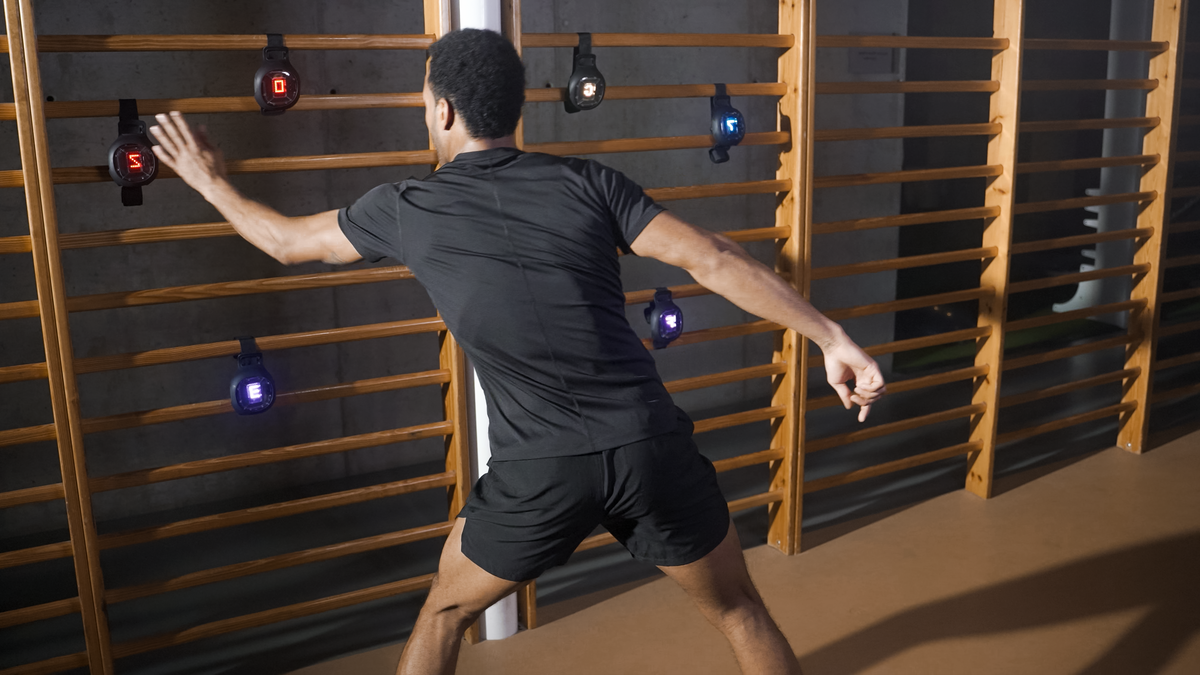

Short answer: A reaction-light training system presents a cue, usually a colored light, and measures how long you take to respond to it. Each pod or sensor lights up in a sequence the coach or app controls. The moment you react, by touching the pod, passing a hand or body near it, or hitting a target, the device records your response time in milliseconds and triggers the next cue. Over a session it builds a record of how fast and how accurately you respond under pressure.
The loop has three parts: a stimulus (the light, sound or vibration), your decision (read the cue, choose the response), and your movement (the action that clears the pod). Faster, more consistent times across that loop are the point of the training.
Reaction-light systems have moved from elite labs into everyday training for athletes, clinics and coaches. The hardware looks simple, a set of lit pods or sensors, but the value sits in the loop it drives and the data it captures. This guide explains how that loop works, the difference between touch and touchless sensors, why multi-sensory cues matter, and what these systems actually measure.
How do reaction-light training systems work?
Every rep runs through the same three-stage loop, the same loop your nervous system uses to respond to anything in sport or daily life:
- Stimulus. A pod lights up, plays a sound, or vibrates. This is the cue you have to detect. The system decides which pod fires, in what order, and how long it stays active.
- Decision. You process the cue and choose a response. In a simple drill there is one correct action. In a choice-reaction drill, a green light might mean go and a red light might mean hold, so the brain has to select between options before moving.
- Movement. You carry out the response, reaching, stepping, sprinting, or striking, until you clear the active pod. The instant the pod registers your action, it stops the clock and lights the next cue.
The system records the time from cue to clearance for every rep. Train the loop often enough and the decision and movement stages speed up and become more consistent, which is what coaches mean by sharper reactions. Research on reaction time shows it varies by stimulus type and improves with focused, repeated practice (PMC).

What is the stimulus-decision-movement loop?
Sports scientists describe a reaction as perception, then decision, then action. A reaction-light system trains all three at once instead of isolating them:
- Perception is trained by varying which pod lights, how bright it is, and whether a sound or vibration accompanies it.
- Decision is trained by assigning meaning to colors or patterns, so the athlete must choose rather than simply react.
- Action is trained by spacing pods so the response involves a real movement, a lateral step, a reach overhead, a sprint to a far pod.
Because the cues are random and timed, the athlete cannot pre-plan. That unpredictability is what makes the work transfer to a game, a court, or a return-to-play setting, where the next event is never scripted.
Touch vs touchless sensors: what is the difference?
Reaction-light pods register your response in one of two ways. Most quality systems support both, so the drill can match the sport or the stage of rehab.
| Sensor type | How you clear the pod | Best for |
|---|---|---|
| Touch | You physically tap or strike the pod | Hand-eye work, boxing and combat drills, upper-limb rehab, precision targeting |
| Touchless (proximity) | You pass a hand, foot or body part near the pod and a motion sensor detects it | Footwork and agility, sprint and change-of-direction drills, hands-free or contact-sensitive rehab |
Touch sensors reward accuracy because you have to make contact. Touchless sensors let you keep moving at speed without slowing to land a tap, which suits agility and lower-limb work. The ROXProX pods read both, so a coach can run a hand-eye drill and a footwork drill from the same set.
Why do reaction-light systems use light, sound and vibration?
Real performance rarely depends on sight alone. A defender reacts to a sound, a runner to a starter's signal, a patient in rehab to a cue they can feel. The average reaction time is roughly 200 to 250 milliseconds for a visual cue, about 170 milliseconds for sound, and around 150 milliseconds for touch, so the cue type changes the demand. Multi-sensory systems use three channels:
- Light trains visual reaction and choice reaction through color.
- Sound trains auditory reaction and lets athletes train when a pod is out of their line of sight.
- Vibration trains tactile response and gives a cue the athlete can feel, which is useful for visually focused tasks and for accessible training.
Combining channels lets a coach build drills closer to the real demands of a sport, and lets a clinician choose the channel a patient can use. Systems such as ROX and ROXProX deliver all three from one pod.

What do reaction-light training systems measure?
The hardware is only half the system. The other half is the data. A reaction-light setup typically captures:
| Metric | What it tells you |
|---|---|
| Reaction time (ms) | How long from cue to response, per rep and averaged across a session |
| Total hits / reps | Work volume in a set time, a measure of work rate |
| Accuracy | Correct responses vs errors in choice-reaction drills |
| Consistency | How tightly your times cluster, fatigue and focus show up here |
| Left vs right / limb symmetry | Side-to-side differences, important in return-to-play screening |
Because the numbers are logged, progress is measurable rather than a matter of feel. The A-Champs app records each session so an athlete, coach or clinician can track trends over weeks. The app has no paywall, so the data and the drill library are available without a subscription.
Who uses reaction-light training systems?
The same loop serves very different users, which is why these systems are multi-sport rather than tied to one game:
- Athletes and teams across soccer, basketball, tennis, padel, combat sports and more, for reaction, agility and decision-making.
- Sports academies, performance centres and training centres, which run many athletes through standardized, measurable drills and compare results over a season.
- Physiotherapists and return-to-play clinicians, who use reaction and limb-symmetry work in rehab after injury, including ACL, concussion and stroke recovery. The Neuro Rehab Set is built for this setting.
- Coaches and trainers who want objective numbers to set targets and show progress.

How do you start training with a reaction-light system?
A simple first session looks like this:
- Place three to six pods in a pattern that fits your space and goal, in a line for footwork, in an arc for reaching, spread wide for sprints.
- Choose a drill in the app and set the duration, number of pods and whether to use color choice.
- React to each cue until the pod clears, then move to the next, for the set time.
- Review your reaction time, hits and accuracy in the app, then repeat and compare.
Tools like ROXCone and ROXClaw extend the same pods to cone drills and grip or reach work, so one system covers a range of patterns.
Want to put the loop into practice? The ROXProX reaction-light system runs light, sound and vibration drills with every rep logged in the app, no subscription required.
Browse the full A-Champs training range to match a setup to your sport, academy or clinic.
Frequently asked questions
Do reaction-light systems actually improve reaction time?
Reaction time responds to focused, repeated practice, and reaction-light drills provide exactly that, random cues, a forced decision, and a measured response. The measurement matters as much as the drill, because it lets you see whether times are getting faster and more consistent over time.
What is the difference between a reaction-light system and a simple light timer?
A light timer measures a single response. A reaction-light system runs sequences of randomized cues across multiple pods, adds choice and multi-sensory cues, and logs the whole session, so it trains decision-making and movement, not just a single press.
Are reaction-light systems only for elite athletes?
No. The same loop is used by youth players, recreational athletes, academies, and physiotherapy and return-to-play clinics. Drills scale by speed, number of pods and complexity, so the system fits the user rather than the other way around.
Do you need a subscription to use the app?
The A-Champs app has no paywall. The drill library and session tracking are available without a subscription.
📚 This guide is part of the Reaction Time Training Hub. Explore all our related guides and drills in one place.

